lunes, 22 de septiembre de 2025

DAILY ROUTINES

DAILY ROUTINES 

Let's review what we learned about daily routines last year! 馃摎

Let's review together so that we can talk about our daily routines.


1. Present Simple for Daily Routines ⏳

We use the Present Simple to talk about our daily routines. Remember:

  • I/You/We/They use the base form of the verb: I wake up at 7 o’clock.

  • He/She/It adds -s or -esShe wakes up at 7 o’clock.

✅ More examples:

  • I go to school at 8 o’clock.

  • She has lunch at half past one.

  • They play football in the evening.

  • He watches TV after dinner.

2. Daily Routines Vocabulary 馃彨馃毑

Some actions we do every day:

  • Wake up 馃泴

  • Get up 馃毝‍♂️

  • Brush my teeth 馃Ψ

  • Take a shower 馃毧

  • Get dressed 馃憰

  • Have breakfast 馃崬

  • Go to school 馃彨

  • Study 馃摎

  • Have lunch 馃嵔️

  • Play with friends 馃幘

  • Do homework 馃摉

  • Watch TV 馃摵

  • Have dinner 馃嵔️

  • Read a book 馃摉

  • Go to bed 馃洀️

  • Sleep 馃槾

3. Adverbs of Frequency 馃攧

We use these words to say how often we do something:

  • Always (100%) ✅ I always brush my teeth in the morning.

  • Usually (80%) 馃檪 He usually walks to school.

  • Often (60%) 馃攧 We often play in the park.

  • Sometimes (50%) 馃 She sometimes eats pizza for dinner.

  • Rarely (10%) 馃槙 They rarely go to bed early.

  • Never (0%) ❌ He never drinks coffee.

✅ More examples:
  • I always wake up at 7 o’clock.

  • She usually has breakfast at 8.

  • They sometimes watch TV in the evening.

  • We never eat sweets in the morning.

4. Telling the Time ⏰

We have learned how to tell the time:

  • O’clock 馃晵 → It is three o’clock.

  • Half past 馃暅 → It is half past one.


✅ More examples:
  • I wake up at 7 o’clock.

  • She has lunch at half past twelve.

  • We go to bed at 9 o’clock.

5. Parts of the Day 馃尀馃寵

  • Morning (6:00 - 12:00) 馃寘 → I go to school in the morning.

  • Afternoon (12:00 - 18:00) ☀️ → We play football in the afternoon.

  • Evening (18:00 - 21:00) 馃寚 → She watches TV in the evening.

  • Night (21:00 - 6:00) 馃寵 → He sleeps at night.

6. Days of the Week 馃搮

  • Monday

  • Tuesday

  • Wednesday

  • Thursday

  • Friday

  • Saturday

  • Sunday

✅ More examples:

  • On Mondays, I go to school.

  • We play football on Saturdays.

  • She does her homework on Wednesdays.

jueves, 18 de septiembre de 2025

Get ready!

馃専 Welcome Back! Let’s Review Our English 馃専

Hello, everyone! 馃憢
We are starting a new school year in 4th grade, and before learning new things, it’s important to review what we already know from 3rd grade. This way we’ll be ready to learn faster and better. 馃殌

Here are the most important topics we should remember:


馃搮 Days of the Week

We must know how to say and write the seven days.
馃憠 Monday, Tuesday, Wednesday, Thursday, Friday, Saturday, Sunday

馃敼 Question: What day is it today?
馃敼 Answer: Today is Monday.


馃對️ The Weather

Talking about the weather is fun and useful.
馃憠 It’s sunny / rainy / cloudy / windy / hot / cold.

馃敼 Question: What’s the weather like today?
馃敼 Answer: It’s sunny! ☀️


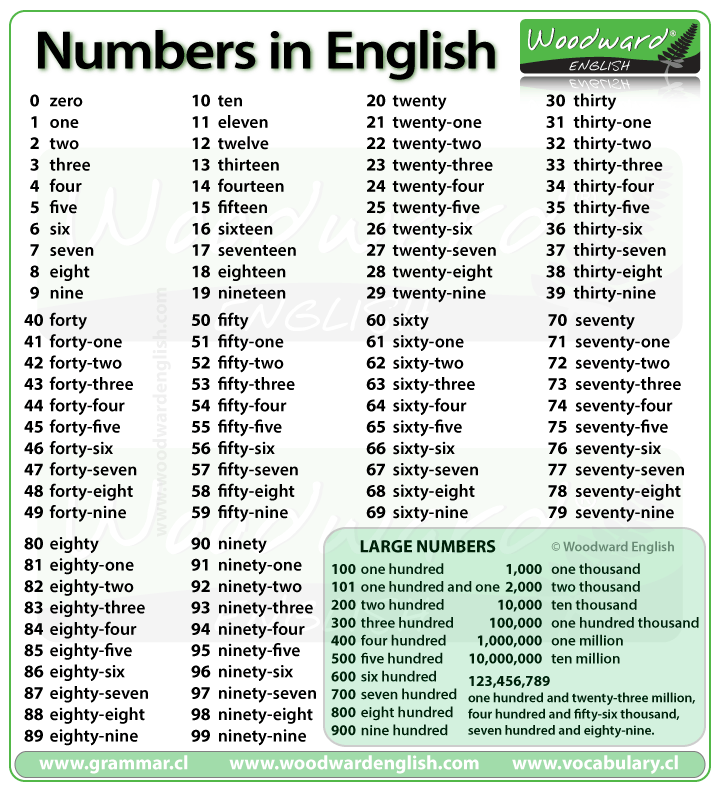
馃敘 Numbers (0–100)

We can count and use numbers for age, prices, or the time.
馃憠 twenty-five (25), forty (40), seventy-three (73), one hundred (100).

馃敼 Question: How old are you?
馃敼 Answer: I’m nine years old.


馃檵 Greetings and Introductions

Saying hello and goodbye is essential.
馃憠 Hello! / Hi! / Good morning! / Good afternoon! / Good evening! / Goodbye! / See you!

馃敼 Question: What’s your name?
馃敼 Answer: My name is Ana.


⏰ Daily Routines

We can explain what we do every day. We use also the adverbs of frequency to say how many times per week we do them.
馃憠 I get up at 8 o’clock. I have breakfast. I go to school. I do my homework. I go to bed.

馃敼 Question: What time do you get up?
馃敼 Answer: I get up at 8 o’clock.


馃崕 Other Useful Vocabulary

  • Colours 馃帹 (red, blue, yellow, green, pink, purple, black, white, brown, orange, grey) 


  • Family 馃懆‍馃懇‍馃懅 (mother, father, sister, brother, grandmother, grandfather) 


  • Classroom objects 馃枍️ (book, pencil, rubber, ruler, desk, chair, bag)


  • Animals 馃惗 (dog, cat, bird, fish, elephant, lion, monkey) 


馃幆 Challenge!

Try to write 5 sentences using today’s vocabulary:

  1. A greeting.

  2. A sentence with the day of the week.

  3. A sentence about the weather.

  4. A sentence with your daily routine.

  5. A sentence with a number. 


馃憠 This review will help us start the year with energy and confidence. Let’s keep learning and having fun with English! 馃挭馃帀


mi茅rcoles, 17 de septiembre de 2025

GAME: Learn your vocab and have fun!

vocab & fun! game The best way to learn your vocabulary is playing, so get ready to have fun with this game! Vocabular...